Acquiring Knowledge, Building Trust: Lessons from Resident Training in Population Health
Find More Posts

May 28, 2026
“Your test results show that you have Type 2 diabetes,” John said gently to his patient, Ana. “I’d like to start you on a daily medication – to be taken with a meal – to help manage it.”
“I don’t have insurance,” Ana said quietly.
John paused. His population health training had educated him for this exact moment – when the usual clinical plan was not feasible for a particular patient due to circumstances beyond their control. What to do next? he asked himself . . . and came up with a suggestion for Ana.
“How’s this?” John asked. “I’ll prescribe you a lower-cost generic medication and look for a pharmacy discount program for you. I can also provide you with some medication samples while I connect you with the clinic’s social worker to explore your financial assistance options.”
Ana nodded gratefully. “Gracias, doctor.”
Though fictional, this exchange represents a common occurrence for clinicians serving patients that are underinsured, experiencing food insecurity, or navigating other adverse social determinants of health (SDOH).
Supported by the Building Trust: Advancing Health Equity grant program, Dr. Krista Johnson and an interprofessional faculty team at the University of Iowa developed the Distinction in Population Health Track. This track was inspired by feedback from internal medicine residents who felt unprepared to care for patients experiencing social and structural barriers to health. This training responds to a present and widespread resident need: training opportunities in population health, advocacy, and community engagement practices that respond to SDOH factors.
The track builds partnerships between residents and local communities through education on health equity, community engagement, and longitudinal patient care in the Iowa City Free Medical Clinic and the Medication for Addiction Treatment clinic.
“The first two years successfully engaged residents in learning and teaching about SDOH and health disparities as well as providing care for underserved populations, locally and internationally,” Dr. Johnson shared. “The track promotes resident learning about SDOH and health equity, advocacy efforts, scholarship for trainees and mentors, and ultimately has fostered passion and interest in population health.” Residents completing the track gain experience in caring for and advocating on behalf of patients from underserved communities and complete a capstone project based on their experience.
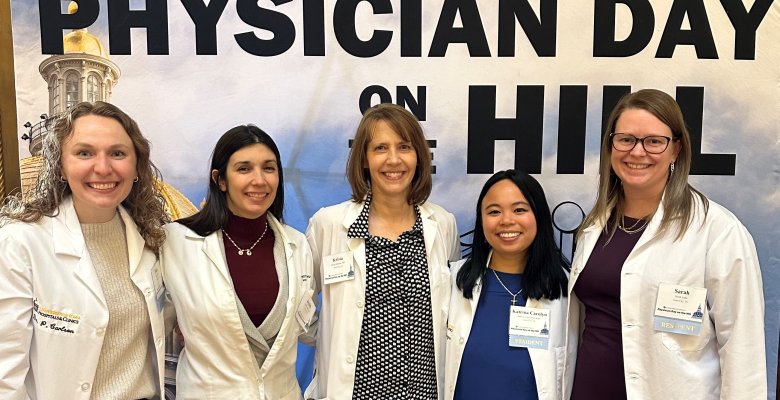
Through the track, residents have presented their capstone projects (such as an advocacy toolkit for physicians) at the University of Iowa Graduate Medical Education symposium and shared their experiences with state policymakers. And the impact on the residents is profound. They report that caring for patients at the Iowa City Free Medical Clinic and Medication for Addiction Treatment clinic and the opportunity to build community with like-minded peers that also have a passion for community-based care is extremely valuable.
Through sharing their experiences, they create ripple effects for the department, the university, and the broader community. Residents teach both their peers and internal medicine faculty about issues in population health. In years one and two, 13 residents taught peers about topics ranging from caringfor indigenous populations to rural health. Residents acquire knowledge, practice it, and pass it on in a continuously expanding circle of care for vulnerable patients.
Through completing curricula on population health, forming longitudinal clinical relationships, and learning how to advocate on behalf of their patients, residents graduating from the Distinction in Population Health Track build trust and confidence in themselves to provide humanistic care that meets the needs of the diverse populations of patients they serve.